I have decided to start putting together a large library of “how to paint” and other work that goes along with miniatures wargaming. The first one is here: https://youtu.be/NGvz3YeNWWc
I would love to get feedback. I am working through the complex video editing software, where the learning curve is very steep.
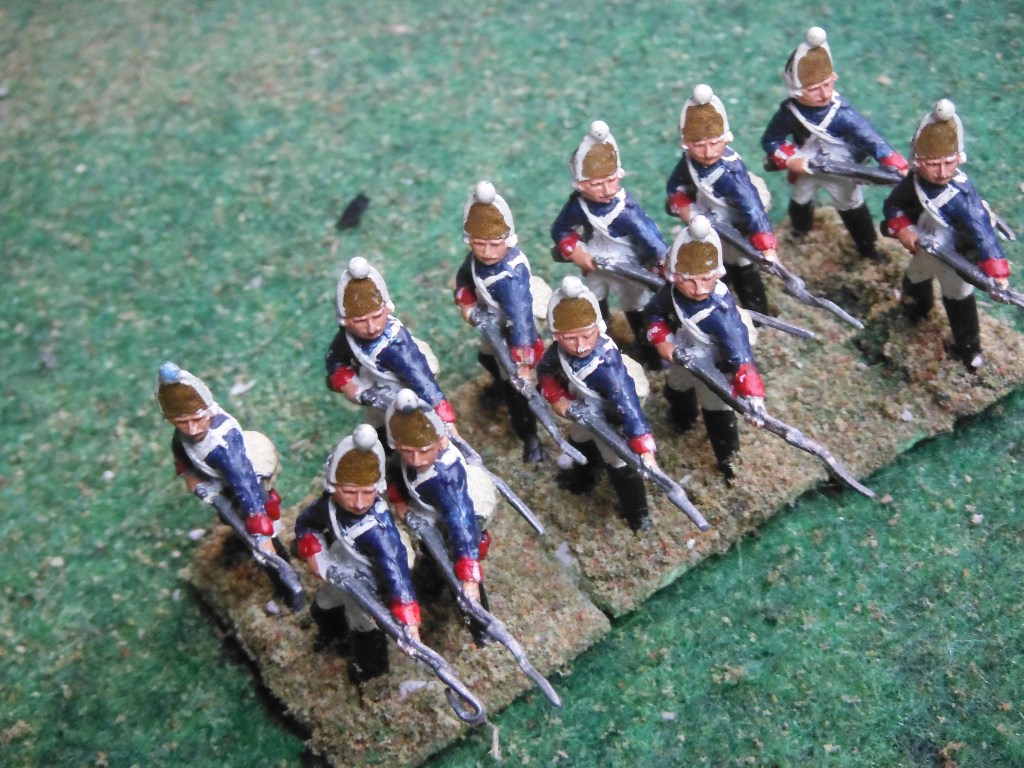
In planning for the games I want to feature at Historicon 2026, I was rummaging through some old boxes and stumbled upon something quite nostalgic. I still have a bunch of the first figures I ever collected and painted. This was in 1976. These figures are from the old “Der Kriegspielers” line (from Duke Siegfried). I figured this would be a great project to bring to Historicon 2026, in celebration of the United States’ 250th anniversary. Most of the figures are unpainted, which I will organize and paint between now and Historicon 2026. Some are painted and I am surprised at how nice they look for a genuine rookie (i.e. me) painting effort.
I dug through the box and have assembled a number of units, enough for a decent 8 player game using the “Koenig Krieg” rules set. No, these are not the greatest rules for American War of Independence, but these will work fine at a convention setting. After all, convention games need to be simple to explain and fast to play…
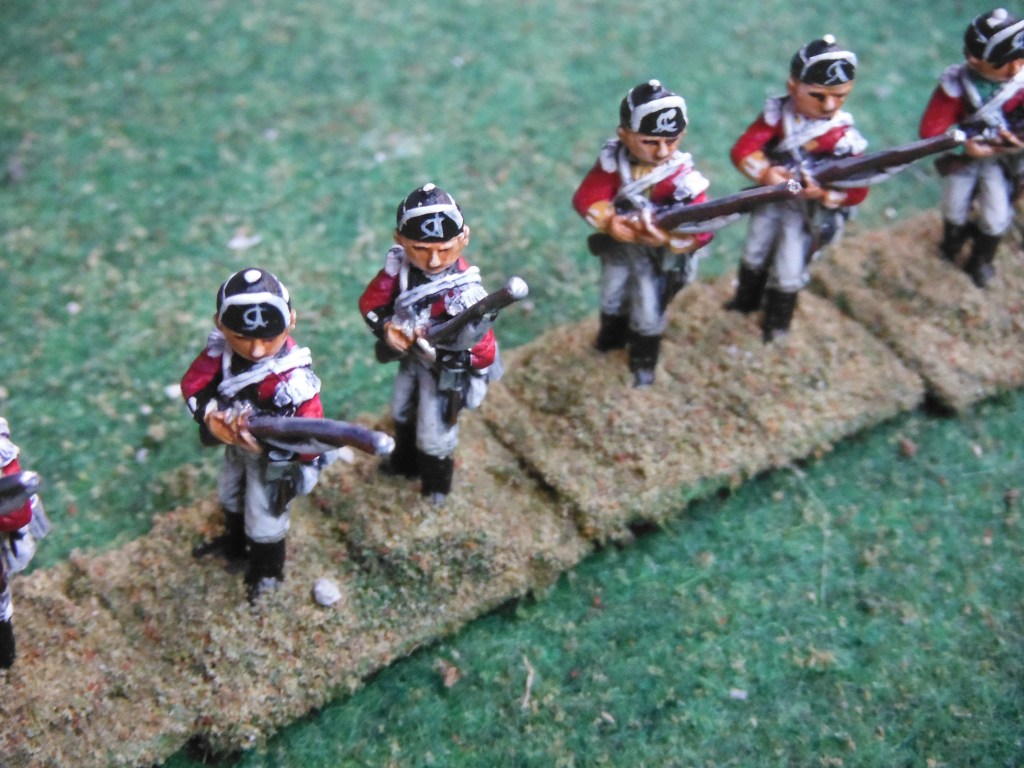
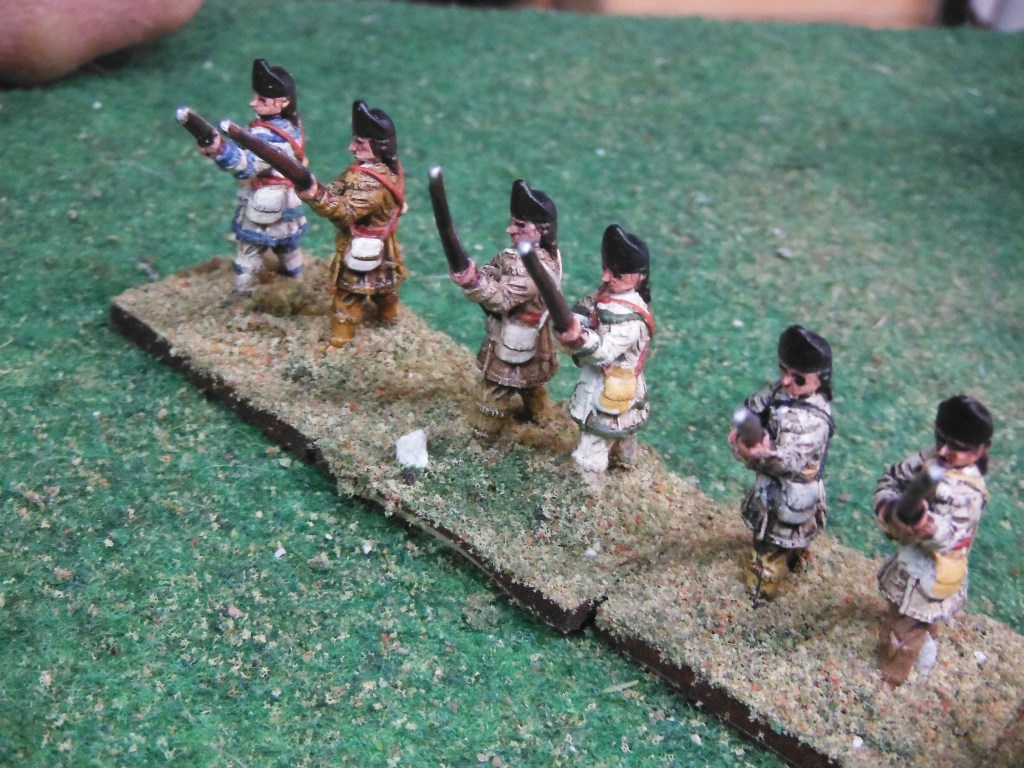
I painted a converged British Light Infantry and an American Rifle unit already. What do you think?
I think these figures still hold up in looks, even after 50 years. They are ‘true’ 25mm, so will not fit into current ideas of what 25mm scale is.
I have to add a few figures to the line by converting some of the bunch I have. For instance, I will convert an Ensign into a Hessian Fusilier, convert a drummer into a Hessian Grenadier drummer, and also convert a cavalry figure into a mounted General. More on those when I get them finished and painted.
I am also planning on another 1/1200 scale Ironclads game and perhaps a WWII 15mm or 20mm SYW event for Historicon. Let me know what may of interest…
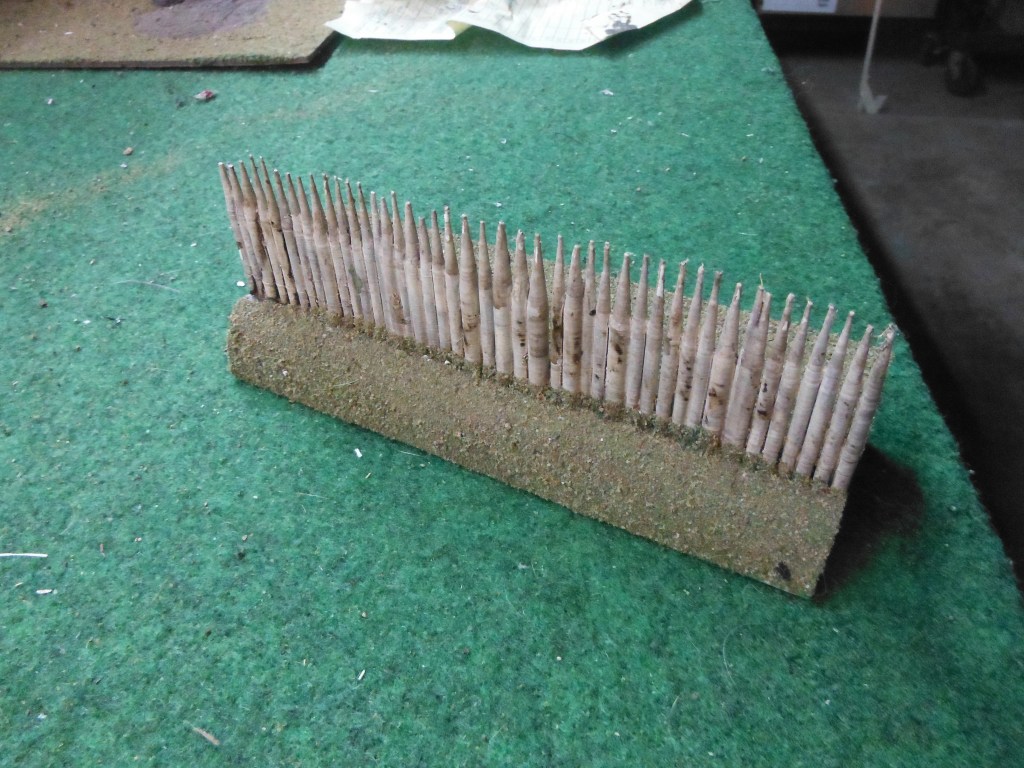
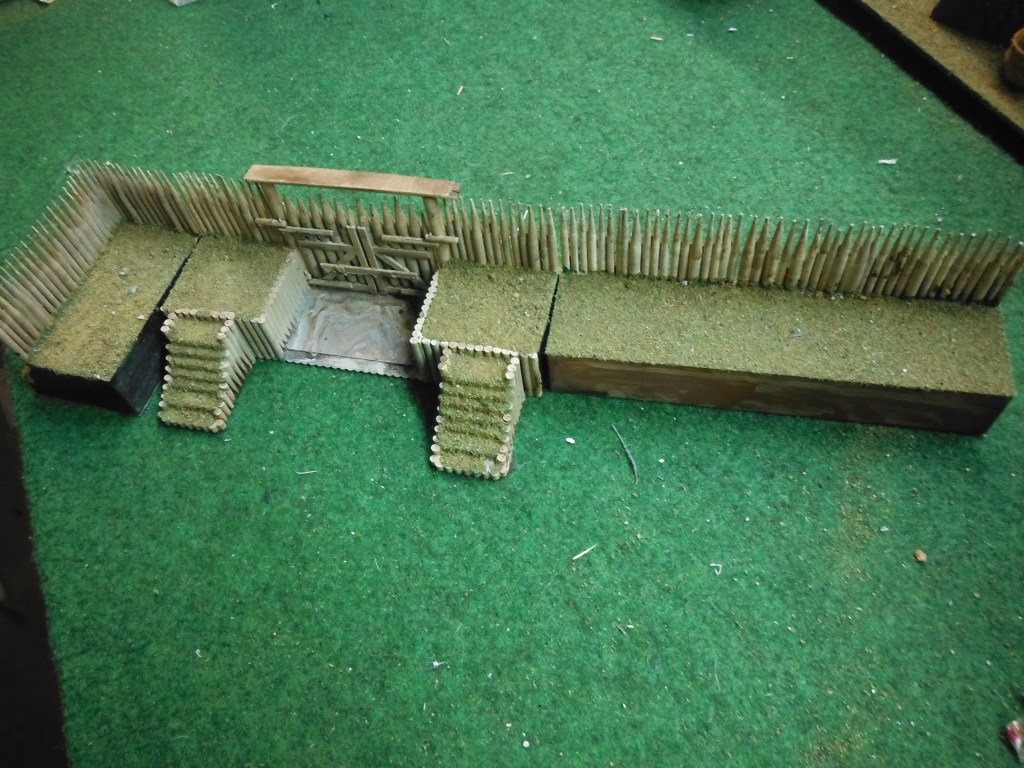
I am working on a number of 3d designs for Roman border walls. Here are some examples of what some of those look like. These are the type the Romans would initially construct along the border, such as the Limes. After a time the Romans would follow up with stone and earth mounds walls.
Just some FYI. I will be setting up the small shop on this site soon. I intend on demonstrating items, such as painted figures or 3d prints and offering these for sale. This will help fund this blog site.
Someone I know was kind enough to review some of the Outland Games Landsknechts figures line. I have to correct him on one minor item…I did not sculpt the original figures. I modified them, though, for my casting molds. I need to contact the sculptor and see if he grants me permission to mention his name here.
Landsknecht Pikeman, Command and Mounted Men-At-Arms Miniature Review by Outland Games
The Landsknecht pikemen were deadly rivals of the famed Swiss Pikemen and a staple of European Renaissance armies, known for their colorful and flamboyant dress as well as their deadly use of pikes. In this review, I’ll be looking at some, which on his website are marketed as 25mm, but blend seamlessly with several 28mm manufactures, miniatures by Outland Games, representing these glorious soldiers.
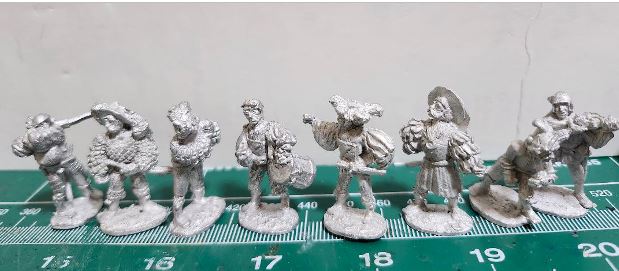
[name redacted by poster], owner and sculptor of the Outland Games Landsknecht line sent me the miniatures in a USPA flat-rate box, bagged, and wrapped in a plastic blister. The packaging provided excellent protection for all but one of the minis during shipping. A Hauptman’s polearm was damaged and I replaced it with brass wire and a spearhead.
Figure 1: Outland Games Sample Figures Provided
The sculpting on this miniature is top-notch. The poses are dynamic, representing the pikemen at rest, and a few as if they’re entering battle with the pike held at an angle as if preparing to thrust. The facial details are excellent, with a strong expression of determination. Most are wearing slashed sleeves and flamboyant feathered hat, which are faithfully recreated, lending to their distinct, iconic look. The lads posed for battle are depicted in armor, which is also meticulously detailed, making it stand out in any battle lineup.
These figures are cast in a softer alloy, which holds detail well without being too brittle, yet easily worked. Some minor mold lines are visible but easy to clean up. The metal castings are sturdy, making them easy to handle during clean up, assembly, and painting.
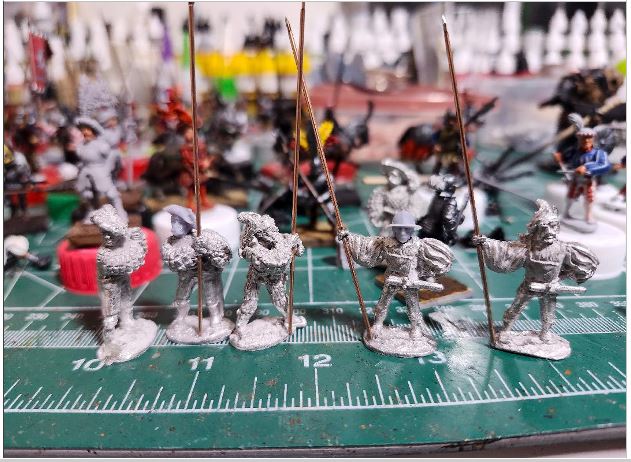
The miniatures came individually cast without pikes. The mounted men were cast separately from the horse. The Drummer had his drum cast attached. The pikes were simple wire pikes sourced from another manufacturer. A simple pin vice drilled the hole through the hand and the pike was superglued in place. I had no issues with either clean up or assembly. I did take the doubles of the figures supplied and swapped heads with some resin sculpts I bought from Etsy.
Figure 2: Outland Games Landsknecht Pikemen at Rest, ready for their primer.
The level of detail on this miniature provides plenty of opportunities for highlighting, shading, and adding intricate patterns to the clothing. The folds in the fabric are deep and clearly defined, which should help with shadow work. The surface texture of the metal alloy is smooth and holds the primer paint well, making it a dream to work on for any painter.
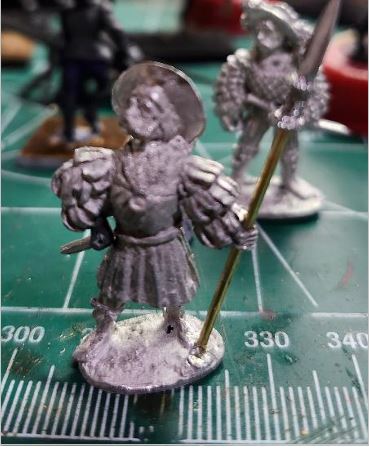
Listed as 25mm they blend with 28mm Landsknecht offered by other miniature companies in that scale. The Hauptman stands slightly taller than some other Landsknecht in my collection, but as people are of differing stature, there is no issue putting a larger man in charge of a unit.
Figure 3: Manufactures from L-R: Old Glory 25s, Perry Miniatures Plastic European Mercenaries, Warlord Games Plastic Landsknecht, Outland Games Pikeman, Warlord Games Metal Landsknecht, Foundry Miniatures Landsknecht, and Steel Fist Miniatures.
Figure 4: Outland Games Landsknecht Hauptman, ready for primer.
Figure 5: Foundry Miniatures Mounted Landsknecht Officer, Outland Games Man-at-Arms, Perry Miniatures plastic Man-at-Arms.
Overall, they are exceptional Landsknecht miniatures that combine historical accuracy with convincing sculpting. They’re perfect for those who appreciate fine detail and want additional figures to expand the variety in their units making them stand out on the battlefield. I highly recommend it to anyone looking to add a touch of Renaissance history to their wargame forces.
Rating: 9/10
Dan [last name redacted for privacy reasons]
Thanks Dan for the lovely comments. NOW we both need to complete painting up our regiments for might Landsknechts clash at some big miniatures gaming show like Historicon!
I had a talk with my friend, Tom about his miniatures rules that reflect unit cohesion. I asked he comment on these below so you can get the complete idea.
COHESION. It’s the name of the game.
By Thomas E. Dye
Prologue
For over 50 years now, historical miniature wargamers have had the same kinds of mechanics appear in almost every set of rules in one form or another. Most continue to look for new rules sets because they become disillusioned from quirky results after a while. Many continue to use them because they are either the most “accepted” local set played or they cannot find others they care to invest the time and money to learn or just force themselves to “like” them as they spent a small fortune for a hardback set that came with all those good-looking figures.
The aim of this section is to inform, discuss and present to you why most systems have problems; what can be done to improve things and leave you with some points to deeply ponder over the next few days.
Introduction
Let me start by asking some questions:
· Why are all units if a class, rated the same?
· Why do most systems track casualties and link them to morale checks?
· What is tracked in a Unit Cohesion game, how and why?
· Why do gamers seemingly insist on worrying about issues like frontages, size of units and a concept called “Command Radius”?
· Why do most rules for historical have to be so complex?
· Why do most historical rules claim to be historical when the historical records are selectively applied, ignoring other, more important, and more relevant factors?
· Does it always have to be a “game” to find fun and entertainment?
I will address each of these topics and what I say here may upset some, baffle others but I hope it turns on that “Light bulb” moment and spurs a few into rereading some research books with different “eyes” for certain things.
Preparing the field for discussion:
Without digging into research books, I would like to establish us on a firm footing of understanding what we should easily understand. Nothing I will address here should be new to the reader. What will be new comes later as I try to show how “traditional” value sets miss the target objectives because they either do not understand how the systems they design don’t match the real-life systems they are trying to model, and why.
· What is a system? Some say that the only “system” is the Solar system. It’s only when we add an adjective to the word system do we immediately begin to understand the concept. A Linear system is one that will always act the same when an input is injected into the system. Take for example a brake system in the car. It will always stop a car when the brake pedal is depressed. If it does not, then an input has been applied to the system. Cut the brake lines once or 100 times, you will get the same results- the car does not stop! This is an example of a linear system. All will act the same until an input is factored into the system. Then, the results of that factor will always produce the same results.
· A Non-Linear system is one that can be infinitely variable. When the same
input is injected into the system; you may not always get the same results due to an
almost infinite number of variables. Once again using cars as an example (we all can
relate to cars, can’t we?) Let’s look at a traffic jam. While you might always have to
suffer in one while driving to or from work every day, the cause for them and who is
affected can vary wildly! Is there always a white car in front of you? Did you have a
disagreement with your spouse this morning? Was the cause of an accident due to only
red cars? Was it a woman driver? Would there have even been an accident if the car
was silver and driven by a man? (Probably not!), but if tomorrow’s traffic jam was
caused by an accident, would the chance be that it was a red car involved, driven by a
woman, with a white car in front of you and you had yet another altercation with your
spouse? (Probably not!) This is an example where in a non-linear system, there can be
so many variables that it would be an astronomical anomaly that every time the same
conditions would produce the same results, with the same people involved, at the
same time, same place, same results! All due to the interactions of all these variables.
What does the color of the car have to do with the accident? On the surface, nothing!
But it remains a variable anyway because the color could change and still result in an
accident! So just because something exists in real life, there is no set formula that
guarantees the same result every time with the same input in a non-linear system.
· Now to tie this into the confines of a wargame. Many rules will rate units into general categories. Elite, veterans, regulars, trained, conscript, irregulars, militia, untrained, etc are all categories I have experienced in rules sets. Usually, every figure or stand is rated for firing at the same value (say “5”). If you have 5 stands the unit fires at a factor of 25. If only 3 stands, 15 and with 6 stands 30. This is an example of a linear wargame system. The inject is the number of stands firing and the constant is the value of “5”. Every 5 stand unit will always have a fire factor of 25. Add another inject: Nationality: now you play with how this nation’s line infantry will be rated. Let’s say a “4”. Does this make for a more “realistic” wargame because you now are imposing a lesser value for this nation’s units? Some seem to think so!
· In reality, units are made up of men. Each one is an individual and is NOT a clone of the other! This means that every unit is made up of a large variable because each man is different. This can be applied to the same logic that every unit will be different because each is made up of different men! So immediately, we can see that a linear value set has been chosen for a non-linear real-life situation. A very bad choice for modelling a gaming system that claims to be historical I would say! Can you name a few more such examples where in real life, a value set is non-linear, yet game rules apply a linear system to model them with? How about Morale? Firing results? Effective ranges? Quality of leaders on any given day? Movement rates? (Did I miss any?)
Cohesion. It’s the name of the game does not use charts (except for ranges by the period being played) nor cards. The game is based upon the effects on the unit and all focuses upon the unit’s leadership’s ability to maintain control over the men. This can fluxuate up or down in the unit’s capabilities- very much a floating target. At the same time, we track losses to the unit’s cohesion in 25% increments. Lose 100% and immediately the unit comes off the board. Similarly, a unit that regains 100% cohesion will reduce it’s recorded number by “1”. This reflects the effect of fatigue on the unit. Units should never be the same rating as what they started as at the beginning of the battle, later on! What follows are the steps needed to prepare your units for game play. Once done, the mechanics needed to play are visible on the table and no charts, modifiers for terrain, etc. are required for play. It will all be explained in the rules.
I think I have stayed true to the above principals and still have delivered an enjoyable, fast paced game where you can have LOTS of toys on the table! My last playtest game had 2 Corps on the table; one Union and one Confederate. Each consisted of 2 Divisions, each with 3 brigades of 5 regiments each. Including artillery, there were 1,000 painted 6mm Baccus figures in play. Including teaching the rules, setting up and tear down, played 7 turns and came to a conclusion in 4 total hours! The players really enjoyed the system and were impressed how easy it could be to use historical data to create units with. Below is just an intro, with rationale, to give you a taste of where “Cohesion. It’s the Name of the Game” is coming from. Hope it stimulates your imagination.
The plot thickens….
OK, how can a designer model a non-linear gaming mechanic? It IS possible! Sticking with our morale grade classes, let’s first understand what we must try to model.
· We have already discovered that a unit in real life is a non-linear system. It is made up of men with different skills, attitudes, levels of training and experiences, levels of leadership skills, etc. So which variables seem to have the most impact on a unit’s ability to function? Let’s keep it simple: the training and experience of the men; the training and experience of the leadership and (most importantly) how long have these men served under these leaders? In pregame preparation, we need to determine these qualities and rate them based upon what we know and what we must derive when values cannot be determined. When all else fails, simply roll on a table for these values. Once a value for each has been arrived upon (yes, I have devised such a random value table, please see below). You roll a 1D10 and compare under “value”) we need to consider if any of the three areas should be rated more than the others due to the importance of the quality. In this instance, I have weighted the quality of how long the men have served under these leaders as being more important than the other two. Remember that it is the job of the unit’s leadership to keep the men functioning as a unit. Without that, the effectiveness of how the unit performs is based upon the individuals with greatly varying skills and attitudes being controlled. So, the unit’s rating is ¼ from the training and experience of the men; ¼ from the training and experience of the leaders and ½ from how long these men have served under these leaders. The values assigned from the 3 areas are added together to arrive at a starting unit value for cohesion. (CV). This starting CV is recorded under the base of the unit’s command stand in pencil (as it probably will change as the game progresses and fatigue is accumulated).
Pre-Game Prep: Besides deciding on a scenario and laying out the terrain, deciding who is attacking/defending, the units need to be rated! Here’s how in this basic game:
MATERIALS NEEDED: A quantity of Avery Labels and a pen. Size recommended are ¾ by 5/8 inch. These will be stuck to the bottom of the Battalion’s command stand and leader bases.
Procedure: While you have your command lined up either on the table or off, point to the unit and roll 1d10. Record the die roll on a label and stick it to the bottom of the unit’s command stand. Go to the next unit and do the same. Repeat until every infantry, cavalry unit has been rolled for and every artillery battery has been as well. The numbers recorded are the starting values for the units. Higher is better! Allow one re-roll for anything under a “4”.
All Leaders above unit level (Brigade, Division, Corps) must have a leadership rating. This also reflects the ability of him and his staff’s ability to command the units under them. There are 3 possible values: Exceptional, Average or Poor. Exceptional gets to add 1 to his 1D6 roll once per complete turn. Average gets no modifier so what he rolls is straight the die roll. Poor must subtract 1 from his die roll. So, if a poor general rolls a “1”, he cannot use any influence this complete turn! On the leader’s base, record what his training and experience rolls added up and remember to divide by 2 (rounded up). This will be important and explained in the Command-and-Control section.
This is how to determine starting unit cohesion for units: (roll 2D10 of different colors- 1 for the men and the other for the officers). Read down from the die roll and note the number. Do this for the Training, and experience, add together and divide by 2. Next, roll 1D10 to see the value of how long they have served together. Add that number to the training and experience to discover the unit’s beginning CV value.
Command and Control: At the beginning of a complete turn, when the side gets to first activate for the turn, the Division Commander rolls 1D6and modifies the roll by either +1, -1 or whatever he rolled. That is the number of “pips” he can exert over his command for this turn. He then “passes” that influence to the Brigade commander(s) as he sees fit that will further his overall battle plan. Similarly, Brigade commanders (once activated by their Division Comander) will start their turn by rolling a 1d6 and modified in the same way as the Division Commander did. Whatever he rolled (plus whatever pips passed to him by the Division commander- if any) determines how many of his regiments (subunits) he can activate this turn. Once the regiment (or subunit) has performed their allowed actions, place a white pom-pom behind or on the unit to keep track that the unit has activated . At the end of the Brigade’s turn, remove the marker )one by one)after the unit’s cohesion check has been accomplished. (See Cohesion Check ).
Depictions of Units:
Units: Consist of: What looks good to you as long as the unit frontages remain the same. Artillery stands should represent sections of 2 guns so that an 8 gun battery would be of 4 stands. This way, any organic howitzers may be portrayed and their inherent capability to perform high angle fire can be modelled. Combat is done unit upon unit so if there is a slight difference of frontages it will not matter. The intended target unit of the offensive action must clearly be identified by the attacking player.
Infantry: (6mm figures) 24 figures, 8 figures mounted in two ranks, on 3 stands, each ¾ (frontage) by half inch (depth) bases. (Each grouping of 3 stands is an ACW regiment/battalion) Two of these stands may be detached as skirmishers. Skirmishers may fire as individual stands and require at least the command stand to remain in line as supports and the rally point for the skirmishers. They are considered to be spread across the frontage of the deployed unit. Fire at the deployed unit affects the entire unit (as combat is conducted unit against unit) adding 2 pips to the die roll (as a target and skirmishing unit’s die roll). (The chance for a hit does not change but the modified die roll will make it more difficult to score hits.) This represents the switching out of fresh skirmishing subunits to maintain the skirmishing capability. It also serves as the rallying point if the skirmishing stand is forced back. Therefore, skirmish stands may not deploy more than 2 inches ahead of the supports. To form the skirmish formation it takes 2 actions. This rule applies to mounted cavalry units except they may deploy up to 4 inches ahead of supports. (Supports= a line of the same unit.) Units that historically can deploy totally into skirmish may deploy up to 2 bases for skirmishing purposes. For most, this should effectively double the amount of skirmishing stands eligible to fire. Fire at skirmishing stands is at 2 pips more on the die roll to hit than normal due to target density being spread out. Skirmishers charged by infantry may elect to stand and fire or fall back to supports as an action at the time of being charged. If charged by cavalry, skirmishing stands must fall back without a chance to fire. The unit so charged takes a -1CV loss for the effects of having their skirmishers forced back! Any unit attempting to form square against a cavalry charge must roll a CV control check with a +2 to their die roll due to the leadership allowing cavalry to come that close (much harder to get the men to change formation is such a short span of time). Infantry units that do not form square when charged by cavalry from the CV control check will be assessed with a -2 CV loss. Don’t let enemy cavalry get too close unless you have a VERY high CV value!!!!
Cavalry: 12 figures, mounted 4 per 1 inch by 3/4 inch bases (times 3 bases to a regiment). Where cavalry can dismount, one dismounted base represents horse holders and marks the rallying point.
Artillery: One gun and 2-4 gunners mounted on a ¾ inch frontage by a 1 or 1 ½ inch base. (a section of 2 guns). Battalion guns (where applicable) are 1 gun and 2 figures on a 1 inch (depth) by ¾ inch base. Artillery firing at units that are within 25% of their maximum range may be considered to be firing canister. This is represented in combat by adding +3 CV to the firing battery’s current CV value on the chart when making that shot.
Limbers and Wagons: One model and team mounted on a ¾ inch (frontage) by whatever is needed in depth. Represents transport for one Battery or enough supply wagons to support one Brigade.
Organization: Since Brigade sized units activate at a time, let’s discuss what a Brigade consists of:
Infantry: 4- 6 battalions of infantry with an average of 4 battalions being the norm. Up to one stand of Arty can be attached (controlled by the Brigade’s commander).
Cavalry: 2-4 Regiments of cavalry with 2 being the norm. No artillery can be attached in the basic game.
Artillery: Attached to Division level, the only the Division Commander controls the Artillery and can only use the pips that he rolled at the beginning of the turn. Artillery can be attached to a Brigade and is activated by the Brigade commander just like it was another unit. The allocation for most armies will be one Battery for each Brigade fielded. (For one’s side.) The Overall Commander (Division in this case), can allocate some, none or all the batteries to the infantry brigades or he may retain control over them all before the game starts. Any variation of the above is allowable as long as every battery is under the command of someone. Ranges of artillery and other projectile firing weapons systems to be developed by time period/technology of the time for “effective” fire. For most small arms that should hover around 50 to 100 yards in scale. Ranges are based upon the ability to have enough significant effect to possibly cause a loss of cohesion/challenge to the unit’s leadership to keep the men functioning as a unit. It is not based upon losses! The fact that artillery is firing at you might just be enough to require the unit’s leadership to devote time to calming the men down and refocus upon the tasks at hand. Any CV loss taken determines just how much the unit has been affected from being “fresh” from their old current CV rating/value.
Wagons and Limbers: If used, each Brigade of Infantry or Cavalry is allocated one wagon to represent their organic logistical support. If there is not enough wagons to go around to where each Brigade has one then the Division is forced to command the supply wagon(s) and activate by use of the Division Commanders pip. Each Battery is allocated a limber to represent its ability to move during the game. Once lost, guns can no longer move. Brigades will no longer be able to ignore low on ammo results. Each are legitimate targets and can be lost in combat!
I stumbled across this post on infantry maneuver on the battlefield. I found it very interesting. I may reflect this in how I set up one of the projects I am toying with: 3mm SYW.
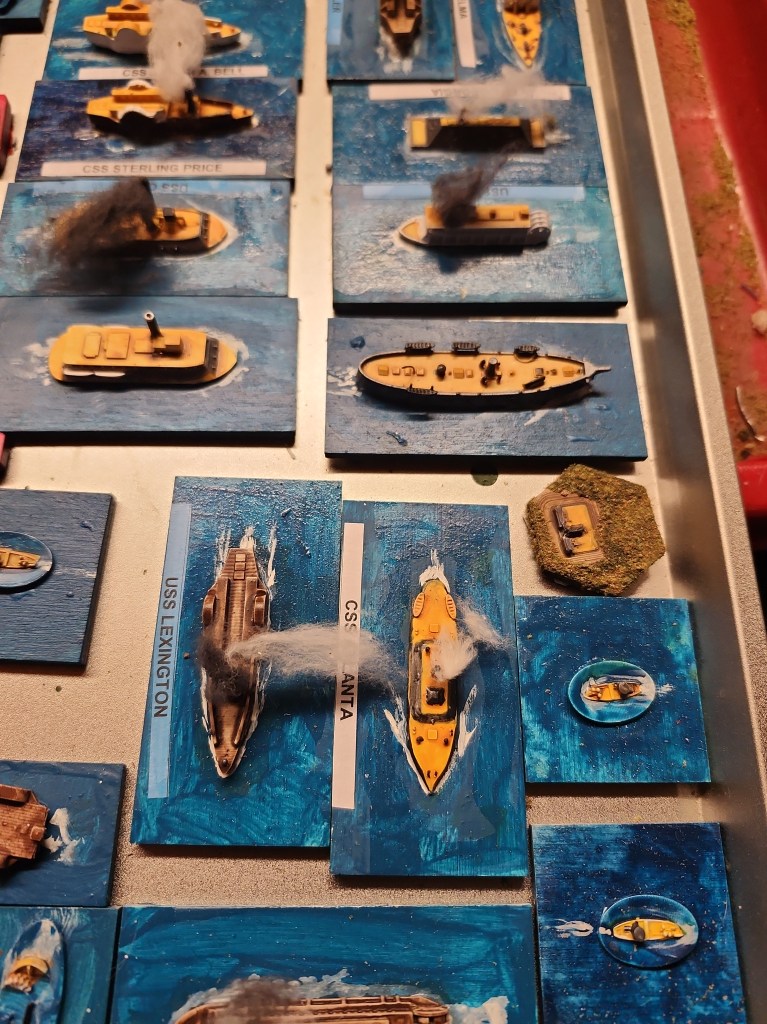
I am gearing up to 3d print a ‘boat load’ of ACW ships. I really enjoy the various challenges of both sides’ naval operations. I already have a nice 1/1200 Mississippi campaign done up for the area (hypothetically) just North of Island #10.
These are from my (albeit smallish) line of ACW ships.





 Outland Games